
 Project home
Direct Stakeholders
USAR and firefighting operations are carried out by a mix of professionals and trained volunteers who work long shifts under high risk and high tempo. Structures differ across Europe (national fire services, civil protection agencies like THW, mixed volunteer/pro units), but field reality is consistent: clear command, sector/task discipline, and pragmatic “get it done” culture. In SYNERGISE we focus first on people who directly touch the technology or whose decisions depend on it. That includes emerging roles (drone pilot, sensor/video analyst, C4I home base operator, information analyst) alongside classic USAR roles (team lead, squad lead, paramedic, search/rescue tech). Interviews repeatedly stressed: don’t make the same person both “set up” and “go in”; treat setup time as an investment only if it clearly pays back in safety, speed, or certainty later; and keep prep at BoO with just-in-time activation at the worksite. New tech must fit rhythms already in use (USAR vs. Fire tempo), respect national certification (e.g., drone licensing), and be configurable to local doctrine while sharing a common core.
Main Stakeholders SYNERGISE technologies
Below are a number of stakeholders that will interact directly with the proposed technologies in SYNERGISE. The term 'First Responder' is an umbrella term for different types of stakeholders. These stakeholders are further identified in the stakeholders this table.
| First Responder (FR) | Form the first response to incidents. INSARAG distinguishes between three First Response organisations: Civil Defence/Protection (police), Local Emergency Services (firefighters and emergency medical technician, EMTs), and Community First Responders. First responders can be local or international, if international help is requested for large incidents. Tasks: breaching, shoring, extrication, interior search. Needs: go/no-go cues, simple wayfinding, hazard alerts that don’t drown out radio discipline. Decisions: continue, withdraw, change access path. Tech: rugged handheld/wearable, glanceable alerts, offline maps. Notes: Avoid alert fatigue; if an alert matters, it must be rare, explainable, and immediately actionable. Setup “on the apron” is fine; strapped-on sensors too early are just dead weight until entry. |
| Victim | Victims can be direct stakeholders, when they have to interact directly with technologies. For example, if victims have to communicate with robot actors, they are directly affected by how these robot actors function. |
Squad Leader (worksite) | Tasks: route choice, team tasking, safety checks, on-site deconfliction. Needs: live worksite map (markers, hazards, team status), quick comms, ability to mute non-critical feeds during critical phases. Tech: role-based dashboard; add/confirm markers; radio + data in one glance. Notes: Wants answers, not raw feeds. Mark-verify-notify loops must be fast. Prefers just-in-time sensor fitting at the worksite. |
| Team Leader (field or HQ) | Tasks: prioritize sectors/sites, assign teams, align with LEMA/OSOCC. Needs: rolled-up picture, change feed (“what changed since last brief”), escalation options. Tech: COP with filters, status roll-ups, one-click briefing. Notes: Treat setup time as investment. Accepts minor startup cost if it clearly shortens later operations or reduces risk. |
| Drone/Robot Pilot | Tasks: launch, supervise autonomous scans, manual inspection, safe recovery. Needs: stable link, people/drone separation cues, battery/health, quick handover to/from analyst. Tech: low-latency video/controls; airspace & ground-proximity cues. Notes: Split pilot/analyst by default; don’t ask one person to fly and interpret. Fire contexts are truck-based with pilot + observer; USAR can accommodate more pre-entry setup. |
| Sensor & Video Analyst | Tasks: interpret feeds, confirm detections, place map markers, advise routes. Needs: synchronized video/thermal/3D, annotation tools, confidence + “why”, provenance. Tech: layered overlays; flag→mark→notify workflow. Notes: Analysts prefer to push decisions and routes, not heatmaps; they want re-task buttons (“re-scan this door void”). |
| Information Analyst (field or HQ) | Tasks: curate sector/worksite status, maintain “one source of truth,” produce reports. Needs: versioning, role-based visibility, audit trail. Tech: C3I forms, bulk updates, snapshots. Notes: Fights duplication and drift; wants structured fields but fast capture in the field (short forms, later enrich). |
| Paramedic (worksite) | Tasks: triage/treat victims; monitor responder vitals; escalate alerts. Needs: traffic-light for non-medics; drill-down for medics; location-to-patient path. Tech: personal baselines, thresholds, confirm/ack flow. Notes: Keep responders’ privacy by default; show only what a role needs. Escalation should route to medic first, then TL. |
| Structural Engineer | Tasks: assess stability, advise shoring, approve entry. Needs: quick 3D slices of interior paths, hazard overlays, decision log. Notes: Values simple, trustworthy measurements over fancy visuals; wants to annotate “do not cut here / brace here.” |
General insights from interviews with stakeholders
Split control & analysis. Robotics work best with distinct Pilot and Analyst; add an Overview role when multiple robots run. Design implication: default to separate UI profiles and explicit handovers; shared annotations sync by default.
Set up or go in. Frontline shouldn’t run complex tech during entry. Design implication: shift setup to BoO or staging; enable just-in-time activation at the worksite; minimize attach/remove steps.
Investment, not sacrifice. Startup costs must pay back in later speed/safety. Design implication: show expected payoff (e.g., saved search time) and keep setup under a known ceiling.
Answers over feeds. Leaders want decisions and routes, not raw sensor firehoses. Design implication: analyst tools publish recommendations with provenance; commanders get roll-ups and “what changed.”
Graceful degradation. Networks fail; work continues. Design implication: offline-first, store-and-forward, mesh hints, on-device caching; visible confidence and data age.
Role-based privacy. Health and video data need scoped visibility. Design implication: strict role views, consent/ack flows, redaction by default on exports.
All roles within USAR operation
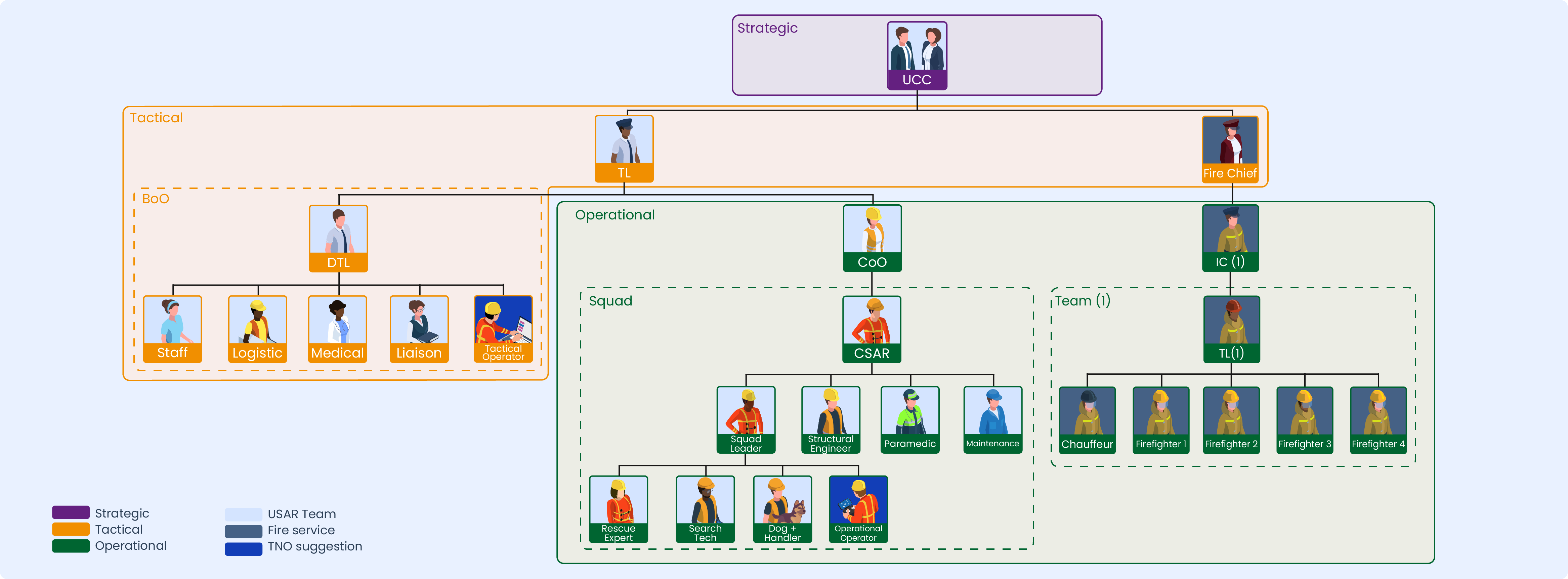
In SYNERGISE, we distinguish between two First Responder departments: Urban Search and Rescue (USAR) and Fire Department (FD). These two department work closely together during an incident. At the end of the overview, some new actors are identified that do not currently exist, but that will need to be included when new technologies are introduced.
| Stakeholder | Description | |
|---|---|---|
 | USAR Coordination Cell Manages the (international) coordination between all stakeholders involved in an incident. | |
 | Team Leader (TL) - USAR Responsible for the whole USAR team. Communication with UCC Participates at the team leader meetings to get tasks assigned | |
 | Deputy Team leader - USAR Responsible for all staff at the Base of Operations (BOO) | |
 | Staff - USAR Located at the BOO. Includes: Information, Staff, Media, ICT, and Hazmat | |
 | Logistics - USAR Located at the BOO. Responsible for logistics of an incident | |
 | Medical - USAR Located at the BOO. Medical professionals. Provides more in-depth assessment of victim health and can perform emergency treatments Tracks the health of first responders Assesses medical equipment for extraction | |
 | Liaison - USAR Located at the BOO. Responsible for the communication with third-party organisations during an incident | |
 | Chief of Operations - USAR Responsible for all rescue operations at all assigned worksites; usually at a worksite during setup and during critical phases | |
 | Chief Search and Rescue - USAR Responsible for all staff at one worksite Contact to Local Emergency Management Ageny (LEMA) at the worksite Using INSARAG Coordination Management System (ICMS) Survey 123 forms Communication/ contact to BoO (Base of operation) Overall strategy and safety in line with guidance by CoO and advice of paramedic, structural engineer and squad leader after initial overview/ survey | |
 | Squad Leader - USAR Located in the field. Leads the technical rescue operation In depth analysis of the situation and solution proposal Close communication with CSAR, structural engineer, paramedic, maintenance and his team In need of all the detailed information, search results, measurements, data etc Decides and guides search techniques, routes inside the worksite and breaking/ breaching as well as rope rescue | |
 | Structural Engineer - USAR Located in the field. Analyses structural integrity of buildings to assess risks of collapse and stabilises buildings where necessary | |
 | Paramedic - USAR Located in the field. Assesses victim health and performs emergency treatment for victim stabilisation where necessary | |
 | Maintenance - USAR Located in the field. Responsible for maintenance during an incident | |
 | Rescue Expert - USAR Located in the field. Expertise in rescuing victims | |
 | Search Tech - USAR Located in the field. Expertise in searching for victims | |
 | Dog + Handler - USAR Located in the field. Searches for (entrapped) victims with the help of scent | |
 | Fire Chief - FD Responsible for all staff at a fire department | |
 | Incident Commander (IC) - FD Responsible for the incident as a whole Communication with the Fire Chief and TLs Chair of the team leader meetings | |
 | Team Leader - FD Participate at the team leader meetings to get tasks assigned Responsible for the whole team Communication with "her/his" IC | |
 | Chauffeur - FD Drives the firefighters to and around the incident | |
 | Firefighter - FD Responsible for mitigating hazards such as fires and gas leaks | |
 | Tactical Operator - NEW Located in the BOO. Responsible for controlling robots remotely. | |
 | Operational Operator (Field Operator) - NEW Located in the field. Responsible for controlling robots on-site. |